What Grew Here: My TCU Harvest
Thoughts on loving and leaving a place, and recognizing what grew in between.
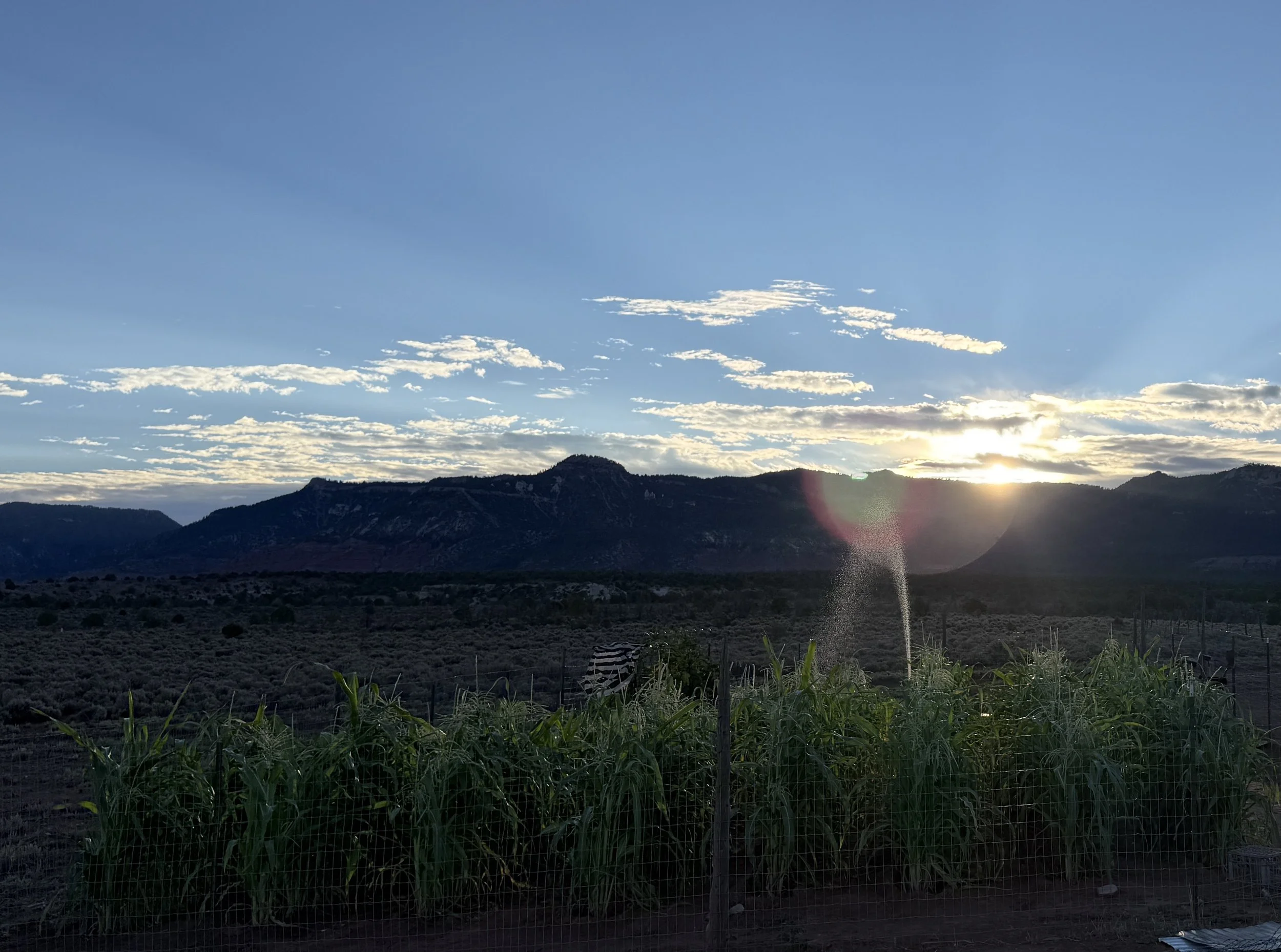
Our da’akeh yazhí in the morning.
I have been thinking a lot about growth lately, especially as our corn is ready for harvest. Maybe that is what happens when you know you are getting ready to leave somewhere. You start looking around differently. You notice what wasn't there when you arrived. You notice what is there now. And, if you are willing to be a little uncomfortable, you notice how different you are too.
When I came to my tribal college, I don't think I completely understood what this place would ask of me. I was literally grateful to just have a job at home. I knew I was going to make the best of it. The rest? 🤣Absolutely not.
I learned how to teach a 5/5 load and somehow keep researching.
I learned how to run grants and create logic models.
I learned how to stay up all night for a ceremony and still show up to teach in the morning.
I learned how to build classes when the classes I felt my students could benefit from did not exist.
I learned how to teach online and still insist that relationships matter on the other side of a screen.
I learned how to push others into seeing sheep, weaving, butchering, art markets, land, family stories, and all those seemingly ordinary things around me as serious intellectual spaces.
I learned how to hold colleagues, superiors, students, and myself accountable, even when it was most uncomfortable.
I am so happy that I did learn all these things because, more than teaching, I love those moments when a student stops me after class because something we discussed made them think about their grandparents differently. I love when a research-methods student suddenly realizes that research isn't something that happens to Indigenous communities. I love when someone realizes their grandmother, uncle, sheep, field, weaving, language, or family story is not outside intellectual life. That is the good stuff.
And because I love this work, I also have to acknowledge something else: Sometimes I have wanted the institution to love the work as much as I did.
There. I said it.
Not with an award;
Not with a disappearing task force role;
And, for the love of the Holy People... not with another committee chair position without a reasonable workload release.
The kind of recognition I was looking at was an understanding that building something takes labor, that changing something takes risk, and that being the person who continually asks, But why can't we? can be exhausting. There were times I felt deeply appreciated here. There were also times I did not. Both are true. And I don't want bitterness to rewrite the first truth simply because I am finally willing to acknowledge the second.
Truth be told, the sum of both realities led to my C.V. and my C.V. now planted the courage to take another risk, one that required a shift in how I understand my responsibilities as a Diné community member and a Diné mother. Staying at my current institution ment continuing to make a direct impact on Diné students albeit with the chance of scoring a yearly contract and feelings of being under/not appreciated. But I’d be within running distance of our home. Leaving oozed a Gerald Vizenor’s understanding of “chance.” That chance would welcome my building, assessing, and flourishing in online Native American Studies teaching and researching position. The rewards of that chance could amount the actually building of a home for my family - literally, a driveway, plumbing, electricity, and a homesite lease with mom’s name on it.
So for the first time since arriving at my TCU, as I harvested our corn in 2025, I started to respond to emails inviting me to apply for R1 positions. It scary not because I didn’t think I could measure up…but because I honestly am a community college harvest: starting my higher education at a community college, most recently completing 14 years of teaching at my tribal community college. I love the missions of the community college. But now I found my toes in the job market that is outside of that mission, being reviewed through another lens. I soon learned of how intensive and slow hiring process was in this new arena… maybe that was the way to ensure a solid fit, a tilling of the lands to see which seed would root best.
I looked at the numbers
As I continued to advance through the various stages of review, I was still trying to make sense of institutional value, institutional appreciation, professional worth and whether I would stay or leave my TCU. Best thing for me was to remain present so I maintained focus on building my domain of online teaching; this included forging into online curriculum’s frenemy territory—Artificial Intelligence, ChatGPT, and National Congress of American Indians’ push to engage AI data centers (I know - this deserves a whole other blog entry… but for now…back to the story). To start to wrap my head around this beast, or at least that minimum start to explore the risk/benefit to Indigenous people, I enrolled in an AI Essentials Course at UNM. The course’s final assignment asked us to analyze qualitative and quantitative datasets. Convenient timing. While judging myself through the eyes of anti - data sovereignty friends as I hit the upload button, I fed AI the dataset sitting right in front of me: my own harvest - my professional dossier - created for two of the two R1 positions I submitted applications to and had received invites for job talks.
I wondered what kind of candidate I looked like through AI's lens, especially since one of the institutions is pushing pro AI in Indian Country from the top-down. But, I also wondered what kind of track record I had built at my tribal college—one that might professionally determine whether my yearly contract was marked “renewable” or “non-renewable,” a very real question that gets posed every spring. Then...I realized neither mattered nearly as much as the professional self-worth I was actually measuring. Funny. What began as an external evaluator, unexpectedly became a mirror, re-confirming what, somewhere underneath all the institutional noise, I already knew.
I wasn't measuring my dossier after all. I was finally measuring what grew here at my TCU.
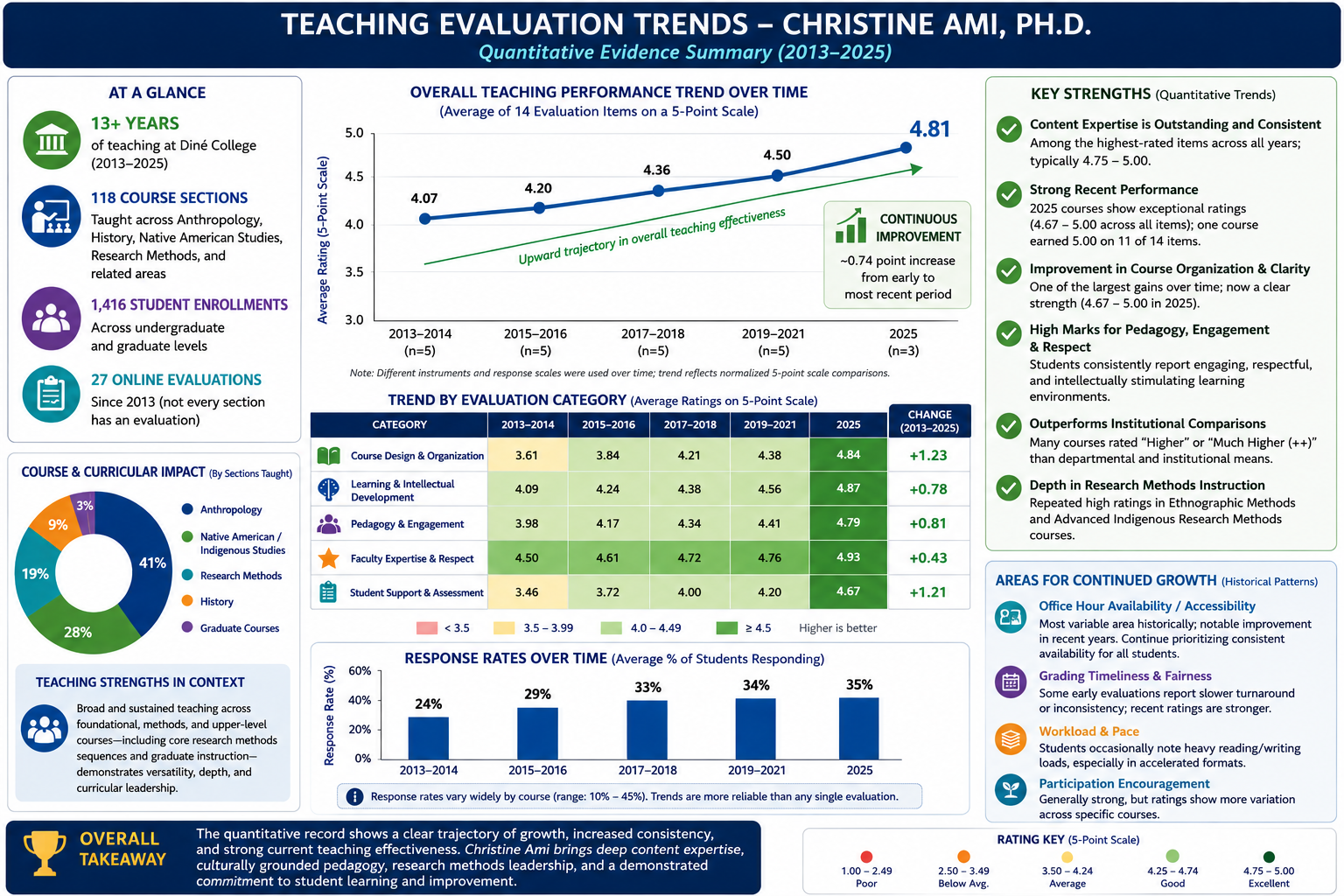
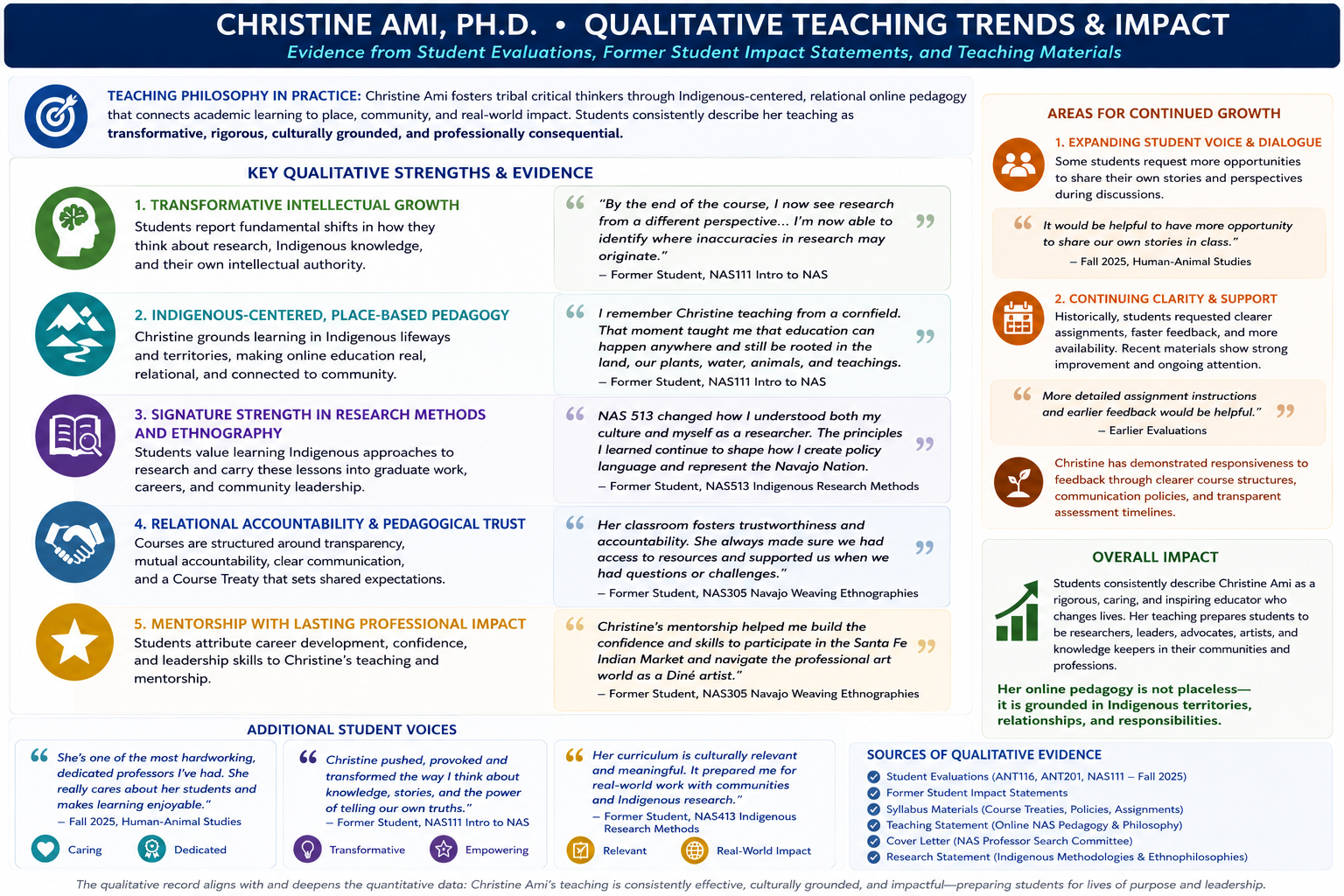
I looked at these numbers not because numbers tell the whole story. If you know anything about my work, you know I am suspicious of anything pretending that a number can contain an entire relationship. While my physical and online presences leave a deep impressions, numbers can leave tracks too. And apparently I have left quite a few: 118 graduate and undergraduate courses - more classes than any individual member of the faculty search committees who would be reviewing my dossier 🙈. Graphs and charts and bullet points detailing more than a decade of teaching classes that existed before me as well as bringing classes into life because I was stubborn enough to keep fighting for them.
Then there were my student evaluations. Those were humbling for a different reason. Early Christine needed some work. She knew her material. Students consistently saw that. But she could be disorganized. She could move too fast. She could expect students to keep pace because she knew where she was going. Sometimes they didn't. Sometimes I probably didn't either. There are evaluations asking for clearer assignments, earlier readings, better organization, more availability, faster grading. Ouch. But they were right. And somewhere between those early evaluations and the professor I am now, something happened.
I learned.
That may sound ridiculously obvious for someone whose profession is education, but professors spend a lot of time talking about student learning and considerably less time admitting that we are supposed to be learning too. And I am not just talking about Diné Educational Philosophy practices through mandatory professional development. We are learning to be community leaders and that's why my recent evaluations look different. The knowledge is still there. But now ...
Clarity shows up.
Organization shows up.
Student engagement shows up.
Respect shows up.
Coupled with my student impact statement letters and qualitative course evaluations, the findings were in: "Christine Ami's teaching is consistently effective, culturally grounded, and impactful -- preparing students for purpose and leadership." That means more to me than a perfect evaluation ever could. Because improvement means I listened to who I was supposed to listen to, the students.
Still, growth isn't the same thing as being appreciated.
It was surreal to find appreciation in the visual 📈📊, appreciation from AI. This is the part I am still working through. For a long time, I think I confused institutional recognition with evidence that the work mattered.
If the program was supported, the work mattered.
If the idea was funded, the work mattered.
If someone said thank you, the work mattered.
And when those things didn't happen? When I didn't have advocacy anymore, well... maybe I wasn't doing enough. So I did more. Here is a big takeaway from my doing more: institutional value and institutional appreciation are not the same thing. We can document the former without exaggerating the latter. You can recognize what you contributed, acknowledge what the institution gave you room to become, and still identify where reciprocity did not always match contribution.
My corn has taught me that, not AI. You don't stand over a field yelling GROW! and then become offended when nothing happens.
You tend it.
You water it.
You protect it.
You recognize what the land can sustain and what it cannot.
Then during harvest, you assess the growth outcomes, recognizing the value and appreciation you offered that helped that corn grow.
That’s where I am now, looking at what grew at my TCU under my care and what didn't. Not everything worked. Some things failed spectacularly. But some ideas…. some ideas grew into courses… into programs… into students doing research I could never have imagined when I first walked into the classroom, into TCU students who are now Ph.D. holders, or running their own art businesses, or starting their own gardens, or picking up the knife for the first time to butcher on their own.
So much growth happened in me too -
I became a better teacher here.
A better researcher.
A better mentor.
Probably a better pain in the ass too. Definitely a more strategic one. :)
I learned that sometimes resistance means an idea needs work—and sometimes resistance simply means you are asking people to imagine something they cannot see yet. I learned to tell the difference. Well...most days. I take these seeds with me for my next harvest.
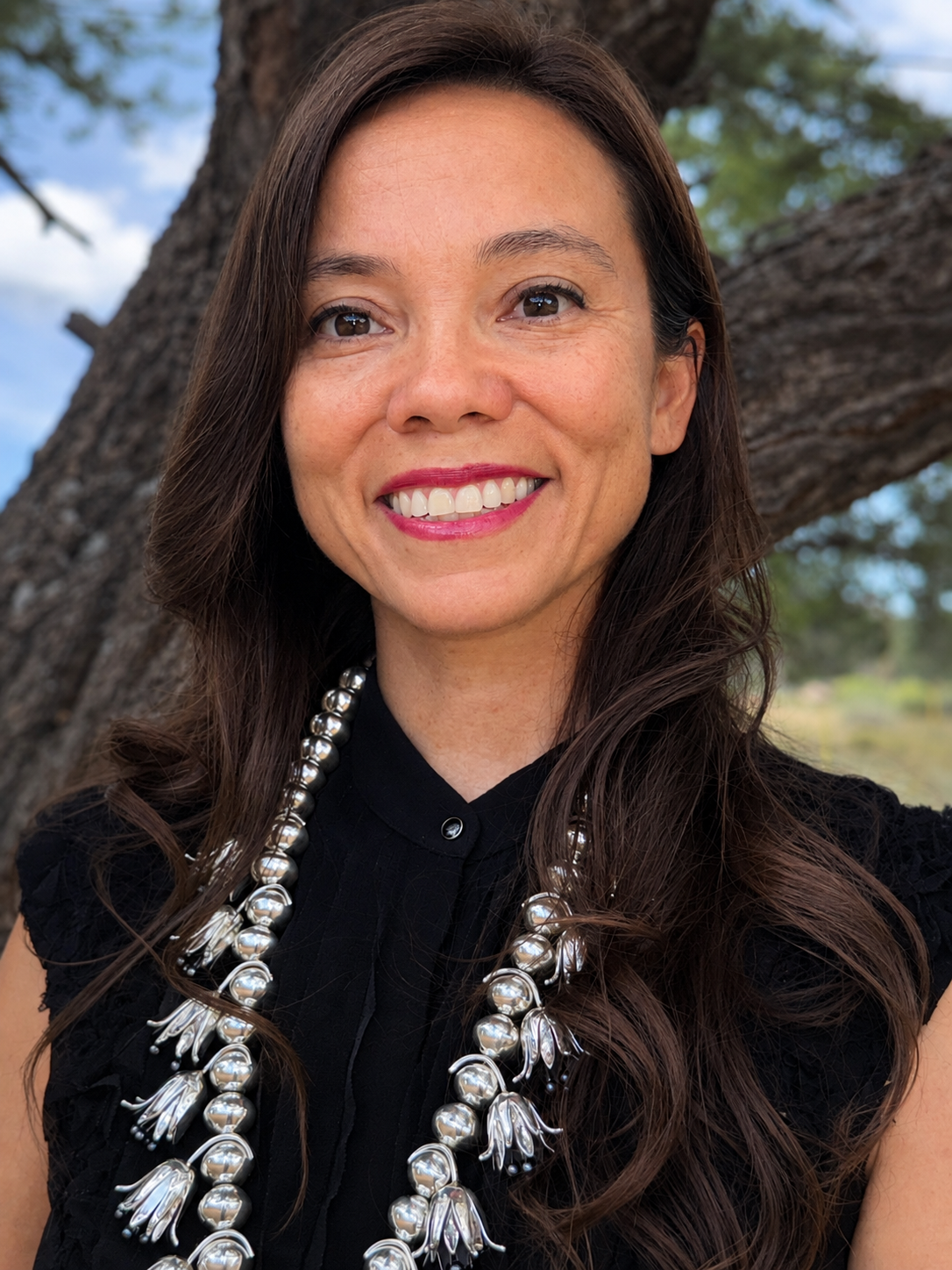
So this isn't a breakup letter.
I have loved this work. Deeply.
My tribal college gave me room to become a professor in ways I don't think I could have predicted. I was able to bring anthropology into conversation with Native American Studies, build Indigenous research into classrooms, teach weaving academically, talk seriously about sheep, and insist again and again that Indigenous intellectual life does not begin when someone enters a college campus. It was already here: In our homes. In our corrals. In our stories. In our languages. In our relationships. I just got a Vizenorian chance to teach some of it.
Years ago, I wrote about my mentor Zoila teaching me to dance strong in academia. My tribal college taught me something slightly different: how to stand. Not still. Certainly not quietly. 😂 But firmly. I know what kind of teacher I am now. I know what kind of scholar I am. I know what I can build. I know what I still need to work on. And I can say all of that now without allowing it to consume everything else. Because appreciation is wonderful. But appreciation is not the same thing as worth. That one took me a while.
I think about it now when I store corn seeds for a future field. Not every kernel makes it to be replanted. Some are eaten. Some are lost. Some simply don't make it. But that does not mean the seed that wasn't replanted had no value. Not all corn makes it to the next field. But all corn has self-worth. Including me.
And that brings me to the crazy thing about my TCU worth: I measure up to R1 standards without question. No caveats. No asterisks. At least, no questions have ever been posed to me directly. Maybe that's a silly thing to think about. Maybe it's not. Because that, to me, is part of the TCU success story. I did not just survive here. I built something here. I became someone here. And apparently, what I built is portable. I can walk into an R1 environment and meet the standards without having to explain why I belong in the room. That feels significant.
And honestly? I see it as a gift I am bringing to my new soil. In a very Robin Wall Kimmerer sense, what has been cultivated here does not belong only to the place where it grew. It carries an obligation to be offered forward—to become something else somewhere else. But let me be clear: this is not me borrowing Kimmerer's language to make myself sound more graceful. This is Christine Ami reality. I know what I have built. I know what it took to build it. I know the intellectual, institutional, and deeply personal labor that went into becoming the scholar who can walk into a new ecosystem and not ask whether she measures up. She does.
And now I get to see what grows in the new soil. I don't arrive empty-handed. I carry students and community with me. I carry failed assignments and successful ones. I carry the lessons that only come from trying something, watching it fail, trying again, and realizing that failure is sometimes just another kind of seed. Mostly, I carry gratitude. Not the polite kind that erases disappointment. The harder kind. The kind that can say:
I love(d) my TCU. This place challenged me. Sometimes this place did not know what to do with me. And I grew here anyway.
As I prepare to harvest what I will carry with me as the Co-lead of the UC Systemwide Native American and Indigenous Studies Online Minor at UC Davis, I know I will break through the R1 soil with community college, Indigenous experiences, and realities that will continue to forge new fields for scholars in unexpected ways.
How will this new soil tend to its seeds? I’m not sure. But I know I am going to make the best of it. And maybe that's the point. You don't transplant a seed so it can become the same plant in a different place. You transplant it to see what else it can become.
So, follow me into this new field: Rez to R1.
